
The Human Constant: Why Relationship Capital Still Outperforms Algorithms in Customer Experience
The Human Constant: why relationship capital still outperforms algorithms when it comes to building lasting customer experience and loyalty.
ARTIFICIAL INTELLIGENCE
Video Guru
7/10/20262 min read

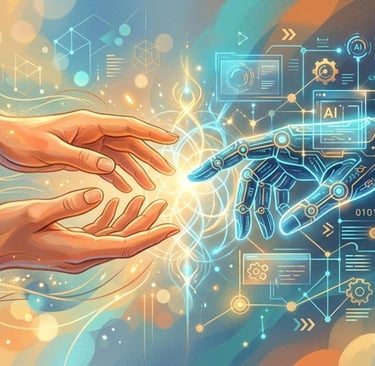
Amid the relentless automation of customer touchpoints, a counterintuitive pattern has emerged: businesses that preserve meaningful human connections consistently outperform fully automated competitors on metrics that matter most. Customer lifetime value, Net Promoter Score, and brand advocacy all correlate more strongly with relationship quality than with response speed or query resolution efficiency. The strategic imperative isn’t choosing between automation and human connection—it’s architecting systems where each amplifies the other.
The neurological basis for human preference in commercial relationships is well-documented. Oxytocin-mediated trust responses activate more powerfully during authentic human interactions than during algorithmic exchanges, regardless of functional outcome quality. Customers remember how interactions made them feel more vividly than what was accomplished procedurally. This biological reality explains why 72% of consumers report switching brands after receiving exclusively automated support during emotionally significant situations.
Smart organizations are implementing what relationship economists call “preserved intimacy zones”—specific interaction categories where human involvement isn’t merely available but actively prioritized. These zones typically include first-time onboarding for high-value products, crisis resolution, loyalty recognition moments, and feedback solicitation. The strategic discipline lies in resisting the temptation to automate these touchpoints for marginal cost savings.
The technical architecture enabling this hybrid approach has matured considerably. Modern customer engagement platforms support seamless context transfer between AI and human agents, ensuring that when escalation occurs, the receiving human possesses complete interaction history, sentiment trajectory, and predicted intent. This continuity eliminates the friction that previously degraded hybrid experiences—customers no longer repeat information, and agents arrive prepared with diagnostic context.
What distinguishes market leaders is their treatment of automation as infrastructure rather than interface. The most sophisticated implementations render AI invisible—handling background research, suggesting response templates, surfacing relevant documentation—while human agents remain the visible presence. This augmentation model preserves relational warmth while capturing efficiency gains, avoiding the uncanny valley effect that erodes trust in overtly automated interactions.
For technical teams evaluating how rendering strategy impacts customer-facing content discoverability, the intersection of JavaScript execution and search engine indexing creates parallel challenges. Resources like https://weboldalkeszites.top/javascript-seo-rendering-strategy-decision.php help teams navigate these decisions, ensuring that dynamic content remains fully discoverable. Just as human relationships require thoughtful architecture to thrive alongside automation, modern web applications demand deliberate rendering decisions to ensure content reaches both human users and discovery algorithms effectively.
The measurement framework for relationship-centric CX differs fundamentally from automation-centric metrics. Beyond cost-per-contact and resolution time, leading organizations track relationship depth indicators: conversation reciprocity, emotional trajectory across interactions, customer-initiated contact frequency, and unsolicited advocacy behavior. These metrics reveal whether automation enhances or erodes the relational foundation of commercial loyalty.
Key Takeaways: - Human interactions trigger stronger trust responses (oxytocin-mediated) than automated exchanges, making relationship quality a stronger predictor of loyalty than efficiency - 72% of consumers switch brands after receiving only automated support during emotionally significant situations - “Preserved intimacy zones”—onboarding, crisis resolution, loyalty moments—should be actively protected from automation, not merely available for human escalation - Invisible AI augmentation (background research, suggested responses, documentation surfacing) outperforms overt automation for relationship-critical touchpoints - Measure relationship depth through conversation reciprocity, emotional trajectory, and customer-initiated contact—not just resolution speed and cost metrics
Resources: https://weboldalkeszites.top/javascript-seo-rendering-strategy-decision.php
Location
3721 Single Street
Quincy, MA 02169
Hours
I-V 9:00-18:00
VI - VII Closed
Contacts
