
Workforce Metamorphosis: Reshaping Customer Service Teams for the AI-First Era
Workforce Metamorphosis: how to reshape customer service teams for the AI-first era — combining human strengths with AI capabilities for superior customer experience.
ARTIFICIAL INTELLIGENCE
Video Guru
7/10/20262 min read
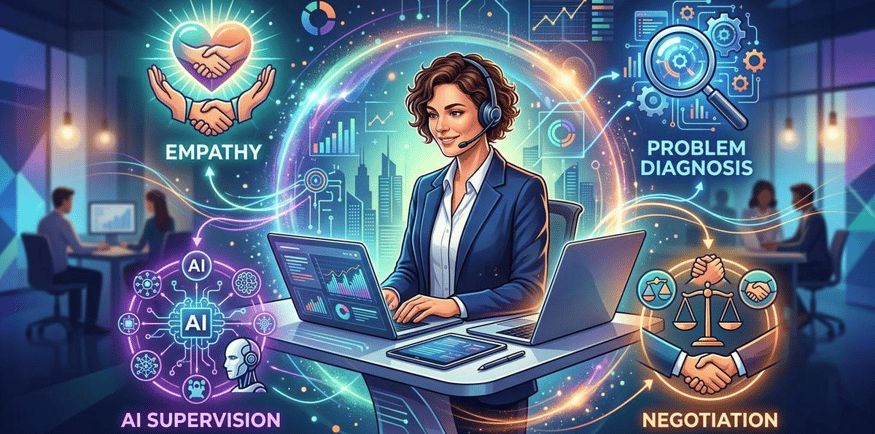
The narrative of AI displacing customer service workers misses a more consequential transformation: the comprehensive reskilling of human agents into higher-value roles that algorithms cannot replicate. As automation absorbs routine inquiries, the remaining human touchpoints grow substantially more complex, demanding entirely new competency profiles. Organizations that proactively redesign workforce capabilities capture disproportionate competitive advantages; those that defer find their human agents overwhelmed by interactions that exceed their training.
The emerging role archetype—variously titled Customer Success Architect, Experience Curator, or Relationship Engineer—combines technical fluency with advanced interpersonal capabilities. These professionals don’t merely resolve problems; they interpret emotional landscapes, identify expansion opportunities, and transform service interactions into strategic relationship-building moments. The skill gap between traditional support agents and these evolved roles is substantial, requiring deliberate investment in capability development.
Technical literacy represents the foundational upskilling dimension. Modern agents must understand how AI systems process inquiries, recognize automation failure patterns, and seamlessly assume control from algorithmic systems without disrupting customer experience. This requires hands-on familiarity with the tools, dashboards, and escalation protocols governing hybrid service architectures. Agents who comprehend AI limitations can identify situations where algorithmic responses miss nuanced context that human judgment captures.
Consultative capabilities constitute the second critical development area. As automated systems handle transactional queries, human agents increasingly field complex advisory conversations—product selection guidance, implementation strategy discussions, optimization recommendations. These interactions demand diagnostic questioning, solution architecture, and value articulation skills traditionally associated with consultative sales roles. Organizations like Salesforce and HubSpot report that agents trained in consultative methodologies generate 40% higher expansion revenue from service interactions.
Emotional intelligence development, often dismissed as innate rather than trainable, yields measurable returns when approached systematically. Structured programs in empathic communication, de-escalation psychology, and trauma-informed service delivery significantly improve outcomes on high-stakes interactions. The most advanced implementations incorporate biometric feedback and conversation analytics to provide agents real-time emotional intelligence coaching.
The content dimension of this transformation deserves particular attention. As agents become primary sources of customer insight, their input into content strategy creates competitive differentiation. Organizations seeking to https://villanyszereles-budapest.blog.hu/2026/06/29/how_to_differentiate_your_saas_seo_content_in_saturated_markets increasingly leverage frontline intelligence to identify underserved topics, emerging pain points, and language patterns that resonate with their specific audience segments. Service teams become an organic intelligence layer, feeding authentic customer voice directly into editorial planning processes.
Implementation sequencing matters. Leading organizations launch with capability assessment frameworks that map existing competencies against target profiles, creating individualized development pathways. Microlearning modules delivered within workflow tools enable just-in-time skill acquisition without disruptive training sprints. Peer mentorship networks and community-of-practice structures sustain continuous development beyond formal programs.
The investment calculus is compelling. Research from Deloitte demonstrates that comprehensive reskilling programs deliver 3.2x return through reduced turnover, increased revenue per interaction, and elevated customer lifetime value. In an AI-first service landscape, human capital development—not headcount reduction—emerges as the dominant value creation strategy.
Key Takeaways: - As AI absorbs routine inquiries, human agents must evolve into higher-value roles like Customer Success Architects with entirely new competency profiles - Technical literacy about AI systems, automation failure patterns, and escalation protocols is foundational for modern service teams - Consultative capabilities (diagnostic questioning, solution architecture) generate 40% higher expansion revenue from service interactions - Systematic emotional intelligence training with real-time coaching feedback dramatically improves high-stakes interaction outcomes - Frontline agent insights provide competitive differentiation for content strategy, identifying underserved topics and authentic customer language - Comprehensive reskilling programs deliver 3.2x ROI through reduced turnover, increased revenue per interaction, and higher customer lifetime value
Location
3721 Single Street
Quincy, MA 02169
Hours
I-V 9:00-18:00
VI - VII Closed
Contacts
